
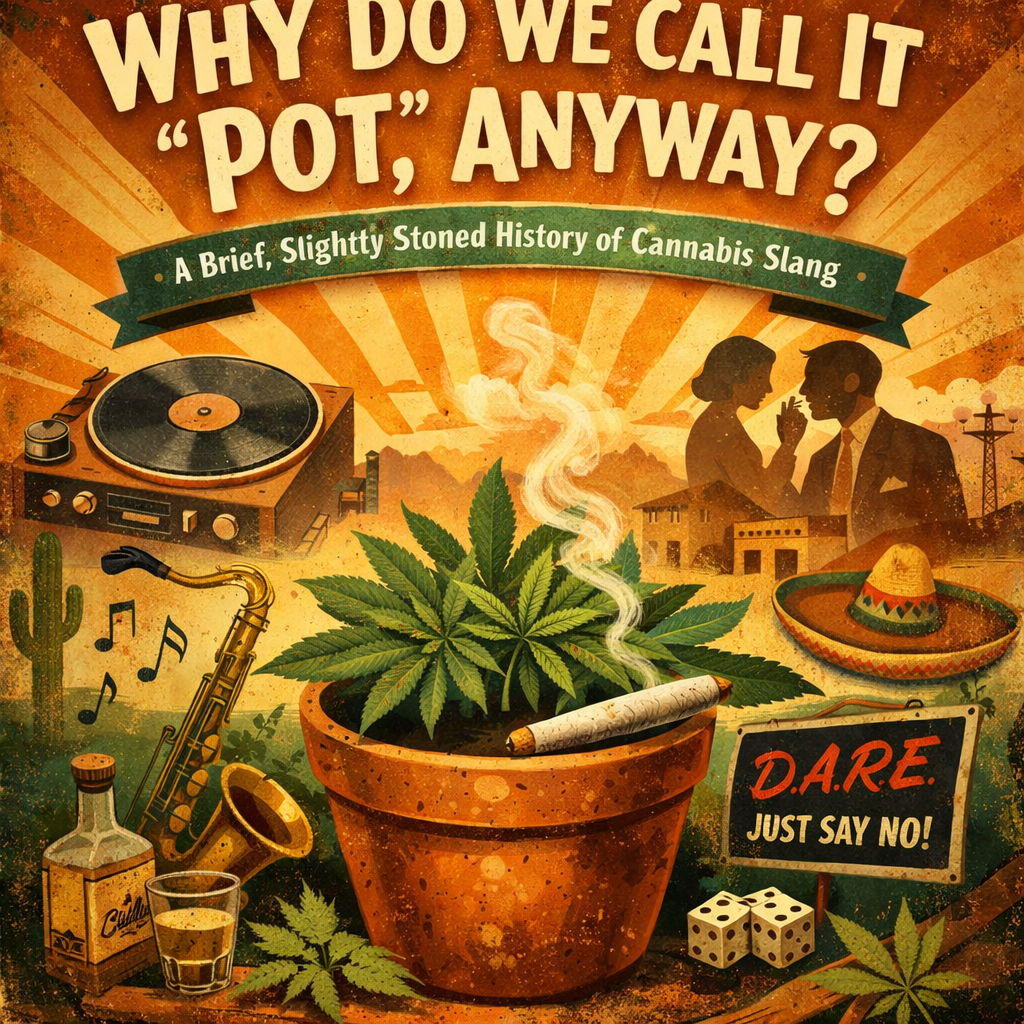

Why Do We Call It “Pot,” Anyway?
A Brief, Slightly Stoned History of Cannabis Slang
You’ve participated in one of cannabis culture’s longest-running identity crises.But before dispensaries, terpene profiles, and sommelier-level strain descriptions,
cannabis had a much simpler nickname: pot. Short. Casual. Slightly rebellious.
And, as it turns out, not nearly as random as it sounds.
So where did the word come from? No, it’s not because your uncle grew it in a clay planter
behind the garage. Let’s clear that up.
The Short Answer (For the Impatient)
The term “pot” most likely comes from the Mexican Spanish word
potiguaya, a slang term used in the early 1900s to describe cannabis leaves or flower
prepared for smoking.
As cannabis culture moved north across the U.S.–Mexico border—especially through Texas and
the Southwest—English speakers shortened potiguaya to “pot.”
Boom. Linguistics. Not cookware.
The Longer (But Still Fun) Answer
In the early 20th century, cannabis wasn’t being discussed in glossy magazines or podcast
studios. It lived in border towns, migrant labor camps, jazz clubs, and underground circles—spaces
where language evolves fast and convenience wins.
Potiguaya itself likely connects to:
- Potación – related to drinks, potions, or herbal preparations
- Regional slang for herbs or leaves
English speakers, doing what English speakers do best, chopped it down to something easier to say.
Thus: pot.
By the 1910s–1930s, the word had entered American slang and started spreading through music,
pop culture, and eventually… your grandparents’ vocabulary.
Let’s Address the Myths (Because There Are Plenty)
You’ve probably heard at least one of these explanations:
- “It’s called pot because it’s grown in pots.”
Sounds logical. Completely unsupported. Nice try. - “Because it makes you potent.”
That’s less etymology and more locker-room philosophy. - “Because it’s like a potion.”
Warmer, but still missing the cultural paper trail.
Fun stories? Sure. Historically accurate? Not so much.
Why “Pot” Stuck Around
Despite newer, shinier terms, pot refused to disappear. Why?
- It was short and discreet during prohibition
- It didn’t sound technical or threatening
- Law enforcement used it
- Parents used it
- Anti-drug PSAs definitely used it
For decades, pot became the catch-all word—especially for people who didn’t smoke it
but were very concerned that you did.
So Why Does “Pot” Feel Outdated Now?
Language evolves with culture. As cannabis shifted from underground to regulated, from stigma to
storefront, the vocabulary grew up too.
Today, pot often feels:
- Old-school
- Slightly judgmental
- Vaguely anti-weed-adjacent
Meanwhile, terms like flower, cannabis, and cultivar
sound more intentional—less “D.A.R.E. assembly,” more “let’s talk terpenes.”
That doesn’t make pot wrong. It just makes it… historical.
The Herbage Take
Calling cannabis “pot” isn’t inaccurate—it’s just a snapshot from a different chapter of the story.
A chapter filled with jazz clubs, border towns, misinformation campaigns, and people enjoying a plant
long before anyone argued about THC percentages on the internet.
So next time someone wrinkles their nose at the word, you can smile and say:
“Actually, it comes from Mexican Spanish.”
Then take a hit and let that sit.
Want more cannabis language deep dives?
Stick around. Culture doesn’t just grow—it evolves.
Stay rooted. 🌱