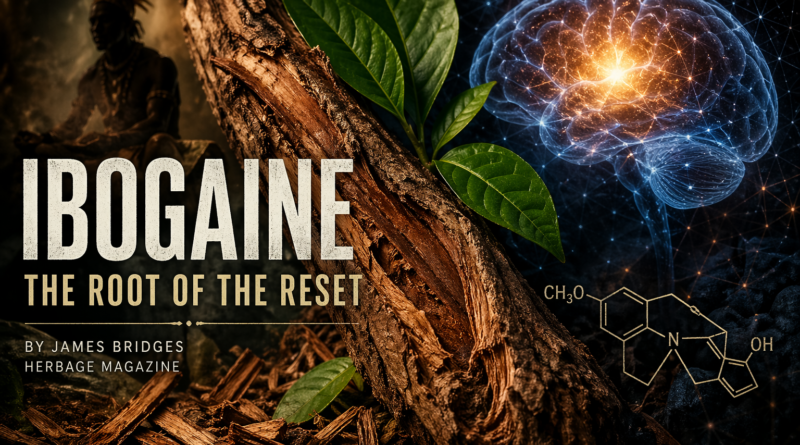
Ibogaine | The Root of the Reset

Ibogaine | The Root of the Reset
By James Bridges | Herbage Magazine
Ibogaine just got pulled into the spotlight, and, as usual, the room isn’t ready for what it actually is.
Most people reading this have never heard of ibogaine.
The ones who have probably heard in a way that sounds half myth, half warning. That’s usually a sign it’s worth understanding. Or at least setting the record straight.
Where It Comes From
Ibogaine is a naturally occurring compound found in the root bark of a plant called Tabernanthe iboga.
It grows in Central Africa, particularly in Gabon, where it’s been used for generations within the Bwiti spiritual practice. It’s used in initiation ceremonies.
The idea is simple and heavy at the same time:
You don’t move forward until you understand where you’ve been.
What It Actually Is
Ibogaine is psychoactive and is a compound that affects the brain and perception. However, it doesn’t behave like most psychedelics you’ve heard of.
There’s no light or recreational version of this. It’s long, intense, and very structured.
The experience usually lasts 12 to 36 hours and moves in phases:
- Onset – physical heaviness, body load, disconnection from surroundings
- Vision phase – vivid, often lifelike sequences of memory, emotion, and pattern
- Processing phase – quieter reflection, where meaning starts to settle in
It’s less like “seeing things” and more like reviewing your own life with the volume turned all the way up.
Why People Are Paying Attention
Ibogaine is getting attention because of what people report on the other side of that experience.
1. Addiction Interruption
Amazingly, people struggling with opioid addiction, heroin, oxycodone, fentanyl, alcohol, and more have reported reduced withdrawal symptoms and dramatically lowered cravings. Many have reported full recovery with zero relapse.
From a biological standpoint, ibogaine interacts with multiple systems in the brain:
- Dopamine — reward and motivation
- Serotonin — mood and perception
- Opioid receptors — the same system addiction hooks into
It doesn’t just hit one switch. Ibogaine hits the whole board at once.
2. Pattern Recognition
During the experience, people often uncover and see:
- How their habits formed
- Where trauma entered the picture
- The loops they’ve been running without noticing
Not as ideas. As lived moments. The big psychological shift comes from this part.
3. Neuroplasticity
There’s growing interest in ibogaine’s ability to promote neuroplasticity. This is the brain’s capacity to reorganize and form new connections. It just so happens that addiction and trauma are, at their core, learned patterns.
If the brain can change, the pattern can change.
What a Treatment Looks Like
A proper ibogaine treatment typically includes:
- Medical screening, especially heart health
- Preparation phase, including diet and substance tapering
- Supervised dosing in a controlled environment
- Monitoring throughout the experience
- Integration afterward, making sense of what came up
The experience itself is only part of it. What happens after is where the real change either sticks or fades.
Research is expanding. Clinical trials are being funded. Policy conversations are shifting. All for the betterment of those that truly suffer.
There’s a growing sense that something important is here, but it hasn’t fully crossed into the mainstream medical system yet.
What It Means
Ibogaine sits at the intersection of a few uncomfortable truths. Addiction isn’t just physical. Trauma doesn’t resolve on its own. Managing symptoms isn’t the same as changing direction.
What ibogaine seems to offer is a moment where all of that becomes visible at once.
Not fixed, but visible.
For most of you reading this, ibogaine isn’t something you’re going to experience tomorrow. But understanding it matters, because it points to a larger shift.
Away from numbing and managing…
and toward actually confronting what’s underneath.